
First Oil Tanker Hit in Hormuz as Iran War Disrupts Global Energy
US-Israeli strikes on Iran trigger first tanker attack in Strait of Hormuz, halting 20% of world oil flows. Gulf producers shutter refineries; oil surges to $120/bbl before paring; stocks tumble, inflation fears mount. Trump hints end "soon" amid midterm risks.
Photo Gallery
What Happened
- US-Israel launches Operation Epic Fury: Joint strikes kill Iran's Supreme Leader Khamenei, dozens of IRGC leaders, and target nuclear/missile sites across Iran (Feb 28).
- Iran retaliates, closes Hormuz: Missiles/drones hit US bases, Israel, Gulf states; declares Strait of Hormuz closed, halting ~20% global oil traffic.
- First tanker hit: Sanctioned tanker Skylight attacked near Oman; traffic slows to standstill.
- Gulf energy shutdowns: Saudi Ras Tanura refinery, Qatar LNG (world's largest), Kuwait/Iraq/UAE/Bahrain facilities halt production due to strikes/storage limits.
- Oil surges: Brent/WTI spike 30%+ to $120/bbl peak; gas prices soar 50% in Europe/Asia.
- Markets crash: Global stocks tumble (S&P -1-2%, Asia -5-8%, Europe erases YTD gains); airlines/defensives hit hardest.
- Iran names new leader: Mojtaba Khamenei appointed; vows no surrender.
- US hints off-ramp: Trump says war ends "very soon"; GOP fears midterm disaster from $3.50+ US gas.
- Global responses: G7 eyes SPR release (300-400M barrels); Korea/Taiwan impose fuel caps; NZ stocks 58 days petrol.
Timeline
-
Feb 28, 2026: US launches Tomahawk missiles over Iraq toward Iran (Story 2). US-Israel "Operation Epic Fury" begins with strikes on >100 IRGC targets, explosions in Tehran/Isfahan/Qom (Stories 1-4).
-
Feb 28 eve: Iran retaliates with missiles/drones on Israel, US bases in Gulf (UAE/Qatar/Kuwait/Bahrain), closes Strait of Hormuz (Stories 1,3,4).
-
Mar 1: Khamenei death confirmed (Stories 1,4). Tanker Skylight hit near Oman (false flag suspicions). Tanker traffic halts; Hapag-Lloyd/CMA CGM suspend transits (Story 1). IDF strikes Tehran (Story 2).
-
Mar 2: Iran drones hit Saudi Ras Tanura refinery (fire, shutdown), Qatar Ras Laffan/Mesaieed LNG (production halt). European gas +50%; oil +13% >$82/bbl (Story 3). Chevron shuts Leviathan field.
-
Mar 3-6: Tankers hit (MKD VYOM, Hercules Star). Iraq/Kuwait/UAE/Qatar cut output; Bahrain Sitra refinery hit. Oil surges 28-36% to $92/bbl. IRGC threatens BTC pipeline (Stories 6-8).
-
Mar 7-8: Iran names Mojtaba Khamenei supreme leader. Trump demands unconditional surrender; oil >$90. Kuwait cuts production. US considers unsanctioning Russian oil (Stories 9,12-15).
-
Mar 9: Oil spikes to $119/bbl then $101. G7 discusses SPR release. Airlines face existential threat; Asia imposes fuel caps (Stories 19,23).
-
Mar 10: Trump hints war ends "very soon." Saudi ramps East-West pipeline to bypass Hormuz. Rand Paul warns of GOP midterm disaster (Stories 29-31).
Key Quotes
"Iran understands that threatening traffic through Hormuz is its most credible asymmetric lever. Even limited interference can raise oil prices and impose immediate economic costs on the US and its partners."
— Fernando Ferreira, Rapidan Energy Group"Oil remains the most direct and liquid expression as a geopolitical hedge – while a full closure of the Strait of Hormuz remains a tail scenario, even a disruption of flows through the Strait... poses an upside scenario closer to $100/bbl."
— Adam Crook, Goldman Sachs"One of the challenges is you can deplete these really quickly. We're using them faster than we can replace them."
— Kelly Grieco, Stimson Center"The endgame remains highly uncertain, ranging from a relatively swift political exit to a broader regional spillover. In such a fog of war, markets tend to trade probabilities rather than shifting facts."
— Mathieu Racheter, Julius Baer
Opposing Views
Main Opposing Views on US-Israel Strikes on Iran ("Operation Epic Fury")
US/Israel Perspective
- Strikes are pre-emptive to eliminate Iran's nuclear threat, IRGC infrastructure, and regime leadership (e.g., Khamenei killed); seen as decisive victory ahead of schedule (Trump: "ahead of schedule," "very soon" end).
- Oil spikes temporary "fear premium" ($100+/bbl); global safety worth short-term pain; US stocks resilient, defense/energy sectors gain (ZeroHedge, WSJ).
- Post-war Iran disarmed, no nuclear/missile threat; potential sanctions relief for pragmatic leadership.
Iran/Regional Perspective
- US-Israel aggression unprovoked; strikes killed civilians (e.g., 165 schoolgirls), hit non-military targets; false flag tanker attacks blamed on Iran (Javier Blas).
- Retaliation justified (500+ US/Israeli sites hit); Hormuz closure strategic leverage; new leader (Mojtaba Khamenei) vows no surrender (Middle East Eye, Tasnim).
- Denies targeting energy; Gulf shutdowns precautionary, blames US for chaos.
Market/Economic Skeptics
- Prolonged war risks $150/bbl oil, stagflation, GDP drag (0.2-1.6% hit to Asia); airlines face "existential threat," global recession (Goldman, Deutsche Bank).
- US midterms disaster for GOP if gas >$3.50/gal (Rand Paul); calls for SPR releases, de-escalation (G7, IMF).
Mitigation Views
- Temporary: SPR dumps, Saudi bypass pipeline, Russian oil waivers (Treasury Sec. Bessent); prices to fall "weeks, not months" (Energy Sec. Wright).
Historical Background
Historical Context: Strait of Hormuz as Perpetual Flashpoint
The Strait of Hormuz—21 miles wide at its narrowest—handles ~20% of global oil (20M bpd) and 25% of LNG trade, per EIA data. Iran's threats to close it date to the 1979 Revolution, when Ayatollah Khomeini vowed retaliation against "enemies." Key past events:
-
1980s Tanker War (Iran-Iraq War): Iran mined the strait and attacked 411 vessels (239 neutral); US reflagged Kuwaiti tankers, leading to Operation Earnest Will (1987)—largest naval convoy since WWII. US downed an Iranian airliner (290 killed), escalating tensions.
-
2019 "Tanker Crisis": Iran seized tankers amid US sanctions post-JCPOA withdrawal (2018). Trump ordered 1,000+ troops; attacks blamed on IRGC raised oil +20%.
These precedents show Iran's asymmetric strategy: disrupt shipping to impose economic pain without full war, forcing de-escalation. US munitions depletion (e.g., Tomahawks from Ukraine aid) echoes post-9/11 strains.
Path to Current Crisis
Trump's "maximum pressure" revived 2018 sanctions, crippling Iran's exports (1.3M bpd to China). 2025 brief US-Israel strikes on nuclear sites spiked oil to $82/bbl but resolved quickly. Escalation to "Operation Epic Fury" (Feb 28, 2026)—killing Khamenei—triggered IRGC retaliation: Hormuz "closure" via mines/drones, Gulf refinery strikes (Saudi Ras Tanura, Qatar LNG, Bahrain). Tanker traffic halted; Gulf output cut (Iraq -70%, Kuwait storage full). Oil hit $120/bbl (Mar 9), gas +50%, fueling stagflation fears.
GOP midterms loom (2026); surging US gas ($3.48/gal, +19%) risks voter backlash, per Sen. Rand Paul. Saudi East-West pipeline (7M bpd to Red Sea) activates bypass, but Houthi threats persist. Past closures lasted weeks; prolonged blockade (>1mo) risks $150/bbl, per Goldman.
Technical Details
Strait of Hormuz Disruption
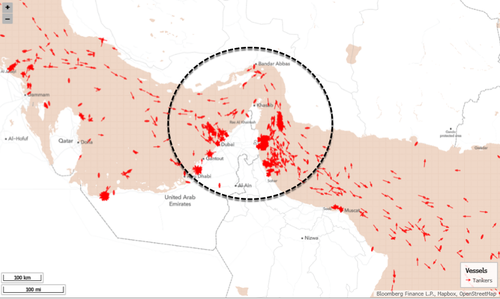
- 20% global petroleum liquids & 27% seaborne oil trade (~20M bpd) halted; AIS data shows tankers in holding patterns, insurers canceling war-risk coverage, raising premiums.
Critical chokepoint (21 miles wide); effective closure via IRGC threats/mines forces rerouting (e.g., Africa’s Cape of Good Hope, adding days/fuel costs).
Tanker & Facility Attacks
- Sanctioned tanker Skylight (Palau-flagged, ~small dark fleet vessel) hit 5nm north of Oman’s Khasab Port; others (MKD VYOM, Hercules Star) damaged/killed crew.
AIS tracking exposed "dark fleet" ops; false flag suspicions as it lingered ~10 days, not crossing strait.
Production Shutdowns
- Saudi Ras Tanura (550k bpd refinery/export terminal) shut post-drone fire; Qatar LNG (77M tonnes/yr, 14 trains, 20% global supply) halted at Ras Laffan/Mesaieed; Kuwait/Iraq cuts due to full storage.
Iran Kharg Island (90% exports) hit; Chevron Leviathan field (21B m³/yr) offline; ~9M bpd offline.
Price Spikes & Reserves
- Brent/WTI hit $119/$119 intraday (highest since 2022), settled ~$90-100 (+28-36% weekly); US gas $3.48/gal (+19% MoM); EU gas +50%, jet fuel +200% Asia.
G7 eyes 300-400M barrel SPR release (25-30% of 1.2B barrels); Saudi East-West pipeline (7M bpd) ramps to bypass Hormuz.
Munitions Depletion
- US stocks drained: THAAD/Patriot/SM-3 interceptors, Tomahawks; "magazine depth" classified but faster burn-rate than production.
Operation Epic Fury: 200+ Israeli jets hit 100+ IRGC/nuclear targets; prior Ukraine war accelerated depletion.
Char: 647
Economic Impact
Energy Sector
Oil & Gas: Strait of Hormuz disruptions (20% global supply) spike Brent/WTI to $120/bbl peak; Gulf shutdowns (Saudi, Qatar LNG, Iraq, Kuwait) remove ~9-15M bpd. Short-term: +30% prices, refiners profit but storage overflows. Long-term: $100+ sustains if prolonged, demand destruction risks.
Defense Sector
Aerospace/Defense: Munitions drain (Tomahawks, Patriots) boosts Lockheed, RTX; stocks +5-10% pre-mkt. Short-term: Production ramp, backlog surges. Long-term: Multi-year contracts, budget hikes if war expands.
Transportation Sector
Airlines/Shipping: Jet fuel +100-125%, crack spreads >$95/bbl; Delta/UAL -6%, cruises -10%. Short-term: Groundings, routes cut. Long-term: Existential threat, bankruptcies if $100 oil persists.
Broader Economy
Inflation/GDP: +0.4pp CPI per 10% oil rise; stagflation fears delay Fed/BOE/ECB cuts (2 hikes priced). Short-term: Gas $3.50/gal US, queues Asia/Europe. Long-term: -0.2pp global GDP, EM hits (Pakistan, SKorea cap prices).
Markets: Equities -1-6% (Asia worst), $ up, yields +4bps. G7 SPR talk caps oil pullback.
X Discussion Summary
Summary of X Discussion on Iran Strait of Hormuz News
Main Themes & Sentiments: Discussion centers on Iran's potential closure of the Strait of Hormuz as a "strategic trump card," warning of severe global fallout—energy shocks, oil prices >$100/barrel, trade disruptions, and financial instability. Sentiment is alarmed and predictive, emphasizing "unpredictable" economic domino effects.
Notable Accounts: @Sputnik (state-affiliated media) dominates with 2 posts citing experts Dr. Ali Mamouri (ex-strategic comms) and Hossam Aiesh (Jordanian economist).
Common Opinions/Reactions: Consensus on catastrophic global impacts; no debates, minimal user engagement beyond shares. Focus: crisis escalation risks.
Nostr Discussion Summary
- No Nostr posts provided.
Return: -
Bluesky Discussion Summary
Summary of Bluesky Discussion
Minimal discussion on Bluesky; only 2 posts identified, both factual reports rather than opinionated reactions.
Main Themes & Sentiments:
- Disruptions in Strait of Hormuz shipping due to strikes on Iran.
- Negative economic impacts: oil price spikes, halted tanker traffic (150+ anchored), higher US gas prices soon.
Notable Accounts:
- @AlanR: Reports standstill shipping, oil fears.
- @janettes-999.bsky.social: Links to Houston pump prices, blames US/Israel strikes.
Common Opinions/Reactions: No debates; uniform concern over energy costs. No broader community engagement.
Full story
A sanctioned oil tanker was struck off Oman's coast amid a near-total halt in traffic through the Strait of Hormuz, the world's most critical energy chokepoint handling 20% of global petroleum liquids and 27% of seaborne oil trade, as U.S.-Israeli Operation Epic Fury targeted Iranian IRGC infrastructure. Iran retaliated by declaring the strait closed, hitting Gulf energy facilities including Saudi Aramco's Ras Tanura refinery and Qatar's Ras Laffan LNG complex, prompting production shutdowns across the region and sending Brent crude surging over $100 per barrel. With tanker traffic at a standstill and insurers canceling war-risk coverage, oil prices spiked as much as 30% intraday before paring gains on G7 talks of strategic reserve releases. The Strait of Hormuz has long been a flashpoint, with Iran exporting 1.3 million barrels per day (bpd) in January—mostly to China—via its "dark fleet" of sanctioned vessels, per S&P Global Energy. Operation Epic Fury, launched February 28, 2026, involved hundreds of U.S. and Israeli jets striking over 100 IRGC targets, including deep in Tehran, nuclear sites, and command centers, amid depleted U.S. munitions stocks from prior conflicts like Ukraine. Iran's Tasnim agency declared the strait closed Saturday, with Mohsen Rezaei warning no American ships could enter the Persian Gulf. Hapag-Lloyd and CMA CGM halted transits, while premiums soared. Rapidan Energy's Fernando Ferreira noted Iran views Hormuz threats as its "most credible asymmetric lever," predicting moderate disruptions with risks of escalation. Goldman Sachs' Adam Crook warned even partial closures could push oil to $100/bbl, risking 2 million bpd of Iranian exports. Events escalated chronologically: U.S.-Israeli strikes killed Supreme Leader Ali Khamenei on February 28, prompting Iran's missile/drone barrages on Israel, U.S. bases, and Gulf states, including Qatar's LNG halt and Saudi Aramco's Ras Tanura fire from drone debris. Sunday saw the Palau-flagged tanker Skylight hit five nautical miles from Oman's Khasab Port—possibly a false flag on its own dark fleet vessel, per Javier Blas—while 150 vessels anchored amid insurer pullbacks. Monday brought Iranian strikes closing Saudi's 550,000 bpd Ras Tanura, Qatar's 77 million tonne/year LNG trains, and Chevron's Leviathan field; Iraq's Kurdistan fields halted 200,000 bpd exports. By Tuesday, Kuwait cut output due to full storage, Bahrain's Sitra refinery burned, and Aramco rerouted via its East-West pipeline to Yanbu. Oil hit $119.50/bbl intraday before G7 weighed 300-400 million barrel SPR releases. Trump hinted at an end "very soon," but IRGC targeted 500+ sites with 700 drones/missiles. U.S. Energy Secretary Chris Wright called the surge a "fear premium," predicting prices below $3/gallon "in weeks, not months," with one tanker transiting Hormuz under escort. Trump deemed it a "small price to pay" for ending Iran's nuclear threat, eyeing sanctions relief for a pragmatic successor. Iranian President Masoud Pezeshkian apologized to Gulf neighbors but vowed retaliation; new leader Mojtaba Khamenei signaled hardline continuity. Gulf states like Qatar warned of $150/bbl oil and global GDP hits; China's Wang Yi decried Khamenei's killing. Experts diverged: Stimson's Kelly Grieco noted rapid U.S. interceptor depletion; Israel's Jonathan Conricus called Iranian response "underwhelming." Sen. Rand Paul warned prolonged action risks "disastrous" 2026 midterms for GOP amid $3.50/gallon U.S. gas. Prolonged closure risks $100-150/bbl oil, per JPMorgan and Qatar's Saad al-Kaabi, squeezing importers like Asia (60% Middle East-dependent) with 0.4pp global inflation hikes per 10% oil rise (IMF's Georgieva). U.S. gas at $3.48/gallon (up 19% monthly) erodes tax cut gains for most; Europe faces diesel/jet fuel crises, with ECB/BOE hikes repriced. Airlines eye fleet groundings (Deutsche Bank); Pakistan rations fuel amid 75% Qatar LNG drop. G7 SPR dumps and Saudi's 7 million bpd East-West pipeline offer relief, but Houthi Red Sea threats loom. A quick off-ramp—via Trump's hinted talks—could stabilize markets; stalemate risks stagflation, recessions in EM Asia (e.g., -1.6% Singapore GDP hit), and GOP midterm losses, per Polymarket's 44% Democrat sweep odds. (4,127 characters)