
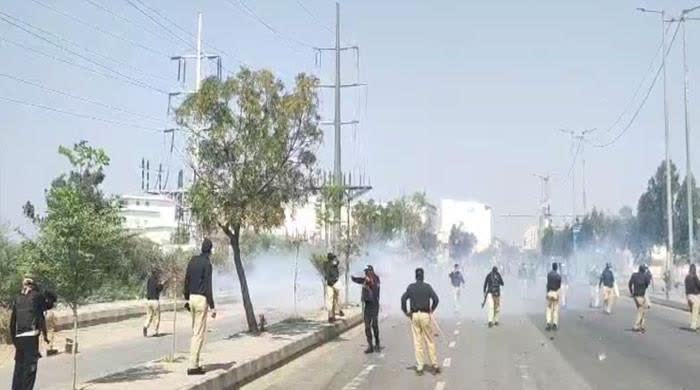
Protesters Storm US Consulate in Karachi, Dozens Dead After Khamenei Killing
Hundreds stormed US Consulate in Karachi, Pakistan, sparking deadly clashes with police; 6-10 killed, dozens injured from gunfire/tear gas. Protests spread to Iraq, Lahore amid fury over US-Israeli strikes assassinating Iran's Supreme Leader Khamenei.
Photo Gallery
What Happened
- US-Israeli airstrikes assassinate Iran's Supreme Leader Ayatollah Ali Khamenei in Tehran.
- Protests erupt near US Consulate in Karachi, Pakistan; crowds storm entrance, smash windows, set guardhouse/police post ablaze.
- Pakistani police/security fire tear gas, batons, rubber bullets, live rounds; protesters clash violently, resulting in 6-10 deaths (mostly gunshot wounds) and dozens injured.
- Edhi ambulances transport injured/dead to Civil Hospital Karachi; hospital confirms casualties.
- Sindh Home Minister demands report, orders heightened security; government forms JIT probe, expresses grief.
- Traffic blocked on Mai Kolachi Road; alternate routes issued.
- Protests spread: Lahore (US consulate attempt repelled), Baghdad (US Embassy/Green Zone), Gilgit-Baltistan (UNMOGIP offices torched, curfew in Skardu).
- Section 144 imposed in Islamabad/Punjab; US Embassy issues safety advisory.
Timeline
-
Saturday (Feb 28, 2026): US-Israeli airstrikes on Tehran assassinate Iran's Supreme Leader Ayatollah Ali Khamenei.
-
Sunday morning (Mar 1, 2026): Protests erupt near US Consulate in Karachi; crowds gather, clash with police using tear gas/batons; injuries reported; Edhi ambulances rush wounded to Civil Hospital.
-
~11am: Karachi Traffic Police close Mai Kolachi Rd, issue alternate routes; Sindh Home Minister seeks police report.
-
Midday: Protesters storm US Consulate in Karachi, breach perimeter, smash windows, set guardhouse ablaze; security fires on crowd.
-
Afternoon: Casualties rise (initially 6, later 9-10 dead from gunshots at Civil Hospital); clashes in Lahore (US Consulate attempt repelled), Baghdad (US Embassy protests), Gilgit-Baltistan (UNMOGIP offices torched, Skardu curfew).
-
Evening: Sindh govt forms JIT, expresses grief; Section 144 imposed in Islamabad/Punjab; US Embassy issues advisory; total ~20+ dead nationwide.
Key Quotes
"No one will be allowed to take the law into their hands."
— Sindh Home Minister Ziaul Hassan Lanjar (Dawn)
"10 had died and 31 were injured... injuries and wounds to all resulted from 'gunshots'."
— Dr. Mohammad Sabir Memon, Civil Hospital Karachi (Dawn)
"Following the martyrdom of Ayatollah Khamenei, every citizen of Pakistan shares in the grief... please do not take the law into your own hands. You may protest but peacefully."
— Interior Minister Mohsin Naqvi (Dawn)
"God willing, we will never bow before America and Israel."
— Mamoona Sherazi, protester (AP)
Opposing Views
Protesters' View
Angry over US-Israeli assassination of Iran's Khamenei; see strikes as aggression fueling regional instability. Chanting "Death to America/Israel," stormed consulate, set fires, viewing it as legitimate outrage (e.g., Middle East Eye, AP reports).
Authorities/Government View
Protests legitimate but violence (breaching perimeters, vandalism) unacceptable; right to peaceful protest but no "taking law into hands." Used tear gas/batons (some reports gunfire); formed JIT probe, imposed Section 144 curbs (Dawn, Sindh Home Minister).
Discrepancies (Indirect Opposition)
Casualty counts vary (6-22 dead); blame on police firing vs. armed protesters; some deny consulate fire (police official). US Embassy monitors, urges caution without blame.
Historical Background
Historical Context: Pakistan-Iran Ties and Anti-US Protests
Pakistan's Shia minority (~20% of population, largest after Iran/Iraq) reveres Khamenei as a spiritual leader since he succeeded Khomeini in 1989 after Iran's Islamic Revolution. Deep sectarian solidarity exists despite Pakistan's Sunni majority.
Past patterns: US diplomatic sites repeatedly attacked during Middle East flashpoints. Key precedents:
- 2012 Benghazi aftermath: Muhammad video sparked deadly Karachi US consulate siege (16 killed).
- 2009/2010 anti-Israel Gaza protests: Mobs stormed/be-sieged US embassies in Islamabad/Karachi.
- 1989 Khomeini fatwa: Similar Shia-led riots hit US missions.
US-Israel strikes killing Khamenei (Saturday) ignited immediate fury, mirroring how perceived US aggression (e.g., Soleimani 2020 killing) fueled nationwide protests. Pakistan's delicate US alliance + Iran border/sectarian ties escalated violence.
Economic Impact
Affected Sectors: Local Transport & Retail in Karachi/Pakistan
Short-term impacts
Road closures (Mai Kolachi Rd) disrupt traffic/logistics, delaying port ops & commerce (~1-2% GDP hit locally). Retail/shops shut in Gilgit-Baltistan; healthcare strains from 100+ casualties.
Long-term impacts
Minimal; localized unrest unlikely to dent Pakistan's $340B economy unless escalates to broader instability. Tourism (GB) dips temporarily from curfews/violence. No global market ripple yet.
X Discussion Summary
Summary of X Discussion on US Consulate Attack in Karachi
Main Themes & Sentiments: Posts focus on violent protests against US strikes on Iran following Supreme Leader Khamenei's death. Predominant sentiment is alarm and outrage, with rapid escalation from storming/fire to clashes, gunshots, and deaths (6-9 reported).
Influential Voices: @OSINTtechnical (initial reports, widely RT'd e.g., @Faytuks), pro-Russia outlets @Sputnik/@RT (sensationalized with "🚨", Khamenei portrait), @TRT World (casualty updates), @Jerusalem Post (video coverage).
Common Reactions/Debates: Factual reporting dominates; no deep debates. Consensus on anti-US fury in Pakistan, regional tensions. Minimal user replies shown, indicating breaking news amplification.
Nostr Discussion Summary
-
Event Summary: Nostr posts report protesters storming the US Consulate in Karachi, Pakistan, after the assassination of Iran's Supreme Leader Khamenei (allegedly by US/Israel). Casualties range from 6-22 killed, with US forces/police firing on crowds.
-
Main Themes: News-sharing dominates (Al Jazeera, AP, ZeroHedge links); anti-US/Iran sympathy; escalation fears in Middle East blowback.
-
Perspectives:
- Pro-protester: US "snipers" fired first on civilians outside gates (post 13).
- Pro-US: Marines defended against "armed Shia mobs"/riots (posts 18,20).
- Neutral: Factual reports of clashes (most posts).
-
Recurring Views: Widespread sharing of casualty figures; hashtags like #Iran #Gaza. Minimal debate, no notable voices. Unique: Pakistan security concerns, global protests.
Bluesky Discussion Summary
Summary of Bluesky Discussion on US Consulate Attack in Karachi
Main Themes & Sentiments: Predominantly alarmist and anti-US, with reports of 6-22 deaths in pro-Iran protests after Khamenei's assassination (linked to US/Israel strikes). Focus on storming consulate, fires, clashes, casualties from security fire/tear gas. Negative sentiment toward US foreign policy (e.g., "US created chaos," "blood on Trump's hands"); fears of escalation, nukes, Benghazi repeats.
Common Opinions/Debates: Blame US/Trump/Netanyahu (e.g., @Lucy Vilchis, @brandnewdaycoming.bsky.social); some defend security ("dumb to breach embassy"). Concerns over regional instability, Iranian sleeper cells (@Nearby). Pro-Palestine/anti-Israel angles (#IranWar).
Notable Accounts/Perspectives: @Jon Gambrell (AP alerts, praised for updates); @sanneru.bsky.social (escalation fears, no plan); @delta (US as "great evil"); @FookyFBSandcat (casualty updates). Satire like "Benghazi" jabs (@socialtwerk.bsky.social).
High engagement on chaos, little support for protests.
Full story
At least nine people were killed and dozens wounded in Karachi on March 1, 2026, when hundreds of protesters stormed the U.S. Consulate, smashing windows, setting fire to a guardhouse, and clashing violently with police and paramilitary forces. The unrest, which also saw attacks on U.S. diplomatic sites in Lahore and protests outside the U.S. Embassy in Baghdad, erupted in response to coordinated U.S.-Israeli airstrikes on Tehran that assassinated Iran's Supreme Leader Ayatollah Ali Khamenei. Authorities reported up to 10 deaths and 31 injuries at Civil Hospital Karachi, with most wounds from gunshots, as tear gas, baton charges, and live fire dispersed the crowds. Ayatollah Ali Khamenei, who assumed Iran's highest authority in 1989 after the death of the Islamic Republic's founder Ayatollah Ruhollah Khomeini, had ruled for over three decades, shaping Iran's theocratic governance and regional proxy networks. The Saturday strikes marked a dramatic escalation in U.S.-Israeli tensions with Iran, amid long-standing accusations of Tehran's nuclear ambitions and support for militias in Iraq, Lebanon, Yemen, and Syria. Pakistan, home to a significant Shiite minority despite its Sunni majority, has seen recurring anti-U.S. protests over perceived Western interventions in Muslim affairs, including past incidents like the 2011 storming of the U.S. Embassy in Islamabad. Shiite groups like Majlis Wahdat-i-Muslimeen (MWM) quickly mobilized, viewing Khamenei's death—described by some as "martyrdom"—as an assault on the broader Muslim ummah. The violence unfolded chronologically on Sunday morning near the U.S. Consulate on Karachi's Mai Kolachi Road. By 6 a.m., 500-600 motorcyclists had gathered, chanting anti-U.S. and anti-Israel slogans while carrying Khamenei's portraits, according to Edhi Foundation rescue worker Imran. Protesters breached the outer perimeter, scaling gates, smashing windows, and torching a guardhouse and nearby police post, as captured in videos verified by Middle East Eye and OSINTtechnical on X (formerly Twitter). Security forces responded with tear gas, baton charges, and gunfire—possibly including from consulate guards—resulting in clashes that left charred motorcycles and spent casings littering the streets. Edhi ambulances rushed the injured to Civil Hospital Karachi (CHK), where police surgeon Dr. Summaiya Syed initially reported six bodies, later revised to nine by CHK trauma center director Dr. Mohammad Sabir Memon, with 31-36 gunshot victims treated. Traffic police closed Mai Kolachi Road, diverting vehicles from Jinnah Bridge to I.I. Chundrigar Road and issuing helpline 1915 updates. By 11 a.m., similar unrest hit Lahore, where MWM activists attempted to storm the U.S. Consulate ahead of a scheduled 3 p.m. rally; one scaled the wall but was released after police negotiations. In Gilgit-Baltistan's Skardu, protesters torched UNMOGIP offices, a school, police station, and Agha Khan Rural Support Programme building, prompting a curfew and army deployment under Section 245 of the Pakistan Penal Code—no deaths reported there. Islamabad imposed Section 144 banning gatherings, with two deaths and 30+ injuries near the Diplomatic Enclave after shelling dispersed crowds marching on the U.S. Embassy. In Baghdad, protesters gathered outside the U.S. Embassy in the Green Zone, accusing Washington of regional instability; Iraqi forces used tear gas to prevent breaches. Punjab province-wide Section 144 followed, barring assemblies of four or more. Sindh Home Minister Ziaul Hassan Lanjar demanded details from Karachi AIG Azad Khan, declaring, "No one will be allowed to take the law into their own hands," and ordering heightened security for installations. The Sindh government expressed "deep grief," formed a joint investigation team (JIT) to probe the clashes impartially, and affirmed protest rights but condemned vandalism. Chief Minister Murad Ali Shah called the incident "extremely tragic," urged religious leaders like Allama Shahenshah Naqvi to calm crowds, and ordered an impartial probe, stating, "At a time when the country is facing a war-like situation, it is inappropriate to sabotage peace." The U.S. Embassy in Islamabad monitored demonstrations at consulates in Karachi, Lahore, and Peshawar, advising citizens to avoid crowds and update STEP registrations. MWM spokesperson Hasnain Zaidi confirmed two Islamabad deaths and 15 arrests. Interior Minister Mohsin Naqvi appealed for calm: "Today is a sorrowful day... protest but peacefully." Protester Mamoona Sherazi in Multan called Khamenei a "fatherly figure" for Shiites and Sunnis. The clashes risk deepening Pakistan's internal sectarian divides, straining U.S.-Pakistan ties amid economic dependencies and counterterrorism cooperation. A JIT probe may clarify gunfire origins—local police, Rangers, or U.S. Marines—potentially fueling lawsuits or diplomatic fallout. Regional escalation looms, with Iran's vowed retaliation possibly drawing Pakistan into proxy conflicts via Afghan borders or Baloch unrest. Curfews, Section 144 bans, and Ranger deployments signal prolonged high alert, disrupting commerce in Gilgit-Baltistan and urban centers. Broader anti-Western sentiment could inspire copycat attacks on diplomatic missions, testing Islamabad's balancing act between public outrage and alliance commitments. As Iran transitions leadership, Pakistan's Shiite networks may amplify calls for solidarity, while global powers watch for spillover into Gulf states or Kashmir.