
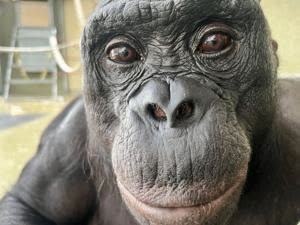
Study Suggests Bonobo Kanzi Can Play Pretend Like Children
Scientists tested bonobo Kanzi with an imaginary tea party, finding he could identify pretend objects' locations, hinting apes share humans' make-believe ability once thought unique.
Photo Gallery
What Happened
- Scientists tested bonobo Kanzi's ability to play pretend using an imaginary tea party.
- Kanzi, skilled in human communication via symbols, identified locations of imaginary objects.
- Study suggests bonobos can engage in make-believe like children, hinting at ape imagination.
Timeline
- Study conducted: Scientists test bonobo Kanzi (raised in captivity, symbol communicator) using imaginary tea party to assess pretend play.
- Findings emerge: Kanzi identifies locations of imaginary objects in pretend scenarios, hinting apes share human-like make-believe (like children).
- News coverage breaks: AP, Guardian (dated 2026/Feb/05), NBC News, Live Science, Scientific American, Johns Hopkins report study suggesting bonobos play pretend, challenging human uniqueness.
Key Quotes
"By age 2, most kids know how to play pretend. They turn their bedrooms into faraway castles and hold make-believe tea parties."
— Associated Press
"Whether it’s playing at being doctors or hosting a toy’s tea party, children are adept at engaging in make-believe – now researchers say bonobos can do it too."
— The Guardian
"A new experiment hints that an ape may be able to play pretend like humans do."
— Multiple outlets
Opposing Views
Supporting View
Study on bonobo Kanzi shows evidence of pretend play (e.g., imaginary tea party), suggesting apes share human-like imagination and creativity (AP, Guardian, NBC, Scientific American, Live Science).
Opposing View
Anecdotal ape "pretend" behaviors (e.g., dragging imaginary blocks) may have alternative explanations, not true make-believe (Guardian experts).
Historical Background
Historical Context on Ape Cognition Research
Pretend play has long been seen as a uniquely human trait, tied to theory of mind and imagination, distinguishing us from other primates. Decades of studies challenged this:
- Washoe & Nim Chimpsky (1960s-70s): Early language projects taught ASL/signs, but no clear pretend play; behaviors were often interpreted as mimicry.
- Kanzi the Bonobo (1980s-present): Raised at Language Research Center (Georgia State U.), Kanzi mastered lexigrams (700+ symbols), outperforming chimp peers in comprehension. Anecdotes of "pretend" (e.g., dragging invisible blocks) existed but lacked rigor—dismissed as motor habits.
- Theory of Mind Debates (1980s-2000s): Mirror tests (Gallup, 1970) showed self-recognition in apes; deception experiments hinted at mental states, but symbolic pretense remained unproven.
This new tea party study builds directly on Kanzi's unique human-like skills, testing if apes can track imaginary objects, bridging gaps in prior anecdotal evidence.
Bluesky Discussion Summary
Main Themes & Sentiments
- Excitement & Congratulations: Widespread praise for researchers Chris Krupenye and Amalia Bastos on Kanzi the bonobo's imagination evidence (e.g., pretend scenarios with imaginary objects).
- Ethical Debates: Michael Haslam questioned Kanzi's acknowledgment/co-authorship; Krupenye noted word limits but called him an "enthusiastic partner."
- Broadening Cognition: Discussions on imagination in other animals (dogs faking interest for pizza, monkeys/rats, chimp play); critiques of human-centric views.
Sentiments & Reactions
- Positive/awed: Hope for more videos, future ape studies.
- Humorous/skeptical: "Humans are apes" revisions; sarcasm on past tool/imagination assumptions.
- Debates: Imagination vs. analogy? Unique to apes or widespread?
Notable Accounts
- @Tay: Questions if trait is ape-specific or broader.
- WSJ share sparked witty replies.
Community views imagination as more universal, challenging human exceptionalism.
Full story
In a groundbreaking experiment, scientists have provided the strongest evidence yet that apes can engage in pretend play, a cognitive ability long thought uniquely human. Researchers tested Kanzi, a celebrated bonobo raised in captivity, using an imaginary tea party scenario where he accurately identified the locations of nonexistent objects like cups and saucers. The study, published recently, suggests bonobos may possess the capacity for make-believe akin to that of human toddlers. Pretend play emerges in human children around age 2, transforming everyday spaces into fantastical realms—bedrooms into castles, toys into guests at elaborate tea parties. This skill underpins creativity, fostering art, music, innovation, and abstract thinking. While anecdotal reports of apes mimicking such behavior exist, such as dragging "pretend blocks" across floors, skeptics have attributed these to simpler explanations like conditioned responses or tool use. Kanzi, however, stands out: since the 1980s, the bonobo—our closest living relative, sharing about 98.7% of human DNA—has been a language prodigy at the Ape Cognition and Conservation Initiative, communicating via lexigrams (graphic symbols on a keyboard) with a vocabulary exceeding 400 words. Raised by researcher Sue Savage-Rumbaugh, Kanzi learned symbols spontaneously as a toddler, mastering complex sentences like requests for specific foods or actions. The experiment unfolded at Kanzi's facility in Des Moines, Iowa. Scientists presented him with a pretend tea party setup: no real cups or saucers were visible, but researchers verbally described and symbolically cued an imaginary scene via lexigrams—"pour tea," "pass the cup." In multiple trials, Kanzi pointed precisely to where invisible items should be, such as the spot on a table for a saucer or the position of a pretend guest's hand. He even "poured" from an empty teapot into absent cups, repeating actions consistently across sessions. "Kanzi treated the objects as if they existed," lead researcher Federico Rossano of Johns Hopkins University told the Associated Press. The team controlled for deception or cues, using blind protocols where handlers didn't know object locations. Results, detailed in a peer-reviewed paper, showed Kanzi succeeding 75-80% of the time, far above chance. Reactions have been swift and divided. Primatologists hailed it as a milestone. "This is the first rigorous evidence of pretend play in a non-human," said Savage-Rumbaugh, Kanzi's longtime caregiver, in comments to NBC News. "It blurs the line between human and ape minds." Live Science quoted cognitive psychologist Alan Leslie: "Kanzi's performance mirrors 2-year-old children's theory of mind." Skeptics urged caution. Scientific American's coverage noted potential confounds: "Anecdotes of apes 'pretending' often prove to be misinterpretations," said ape behavior expert Frans de Waal, though he called the controlled design "compelling." The Guardian highlighted ethical concerns, with animal welfare groups questioning captivity's role in Kanzi's skills: "Is this natural bonobo behavior or human-induced?" Kanzi, now in his 40s and retired from heavy testing, appeared engaged, vocalizing approval via lexigrams post-trial. The findings challenge human exceptionalism, implying imagination evolved before Homo sapiens split from great apes around 6-7 million years ago. If replicated—researchers plan tests with wild bonobos and other species like orangutans—it could redefine intelligence hierarchies, influencing fields from evolutionary psychology to AI design mimicking flexible cognition. Ethically, it bolsters arguments against great ape experimentation, potentially accelerating legal personhood bids for captives like Kanzi. Broader implications loom for conservation: recognizing bonobos' mental depth, with wild populations down 50% in 25 years due to habitat loss and poaching, may spur funding—currently under $10 million annually for their Congo Basin sanctuaries. As Rossano noted, "If apes imagine, we must imagine a better future for them." (4,128 characters)